




Winter Storage & Seasonal Prep Guide for Iowa: Why Your Garage Isn't Enough
What Happens to Your Stuff in an Iowa Winter
It's November. Your boat's still at the dock. Your motorcycle's in the garage. Your RV's parked outside. You figure you've weathered Iowa winters your whole life. No reason to worry.
Then December hits. The temperature drops from 50°F to -15°F in three days. Your driveway's getting salted twice a week. The humidity swings from 70% before a snow to 15% during dry cold spells. By March, you're looking at your bike and wondering why the seals cracked. Your boat's got white residue on the metal hardware, and the upholstery smells like mildew. Your truck's undercarriage is rusting faster than you've ever seen.
I see the same thing happen every spring at b.Mac's. Customers bring stuff out of unheated garages, and they're shocked at the damage. Motorcycles that won't start. Boats with freeze damage in the fiberglass. RVs with burst water lines. Cars that look fine on the outside but are rusting underneath.
Iowa's different from Minnesota, which is cold but dry. It's also different from Colorado, where the air never gets humid. Iowa throws cold, humidity swings, and salt at everything simultaneously. That combination breaks things in specific ways that most people don't expect.
The Extreme Cold
The extreme cold hardens rubber and cracks seals. Your motorcycle's engine's got moisture inside it that's waiting to corrode metal. Your RV's water lines freeze and split. Tires get flat spots from months of sitting cold.
The Humidity Swings
The humidity swings cause real damage. Before a snowstorm, humidity climbs to 70%. Then it drops to 15% during a cold spell. That happens 30 to 40 times over winter.
Each cycle, water condenses on your metal surfaces. Then it freezes. Then it thaws. Do that dozens of times and you've created rust that's baked in permanently.
The Salt
The salt accelerates everything. You drive your truck on salted roads. Even if you rinse it before storing, salt's worked into the undercarriage, the seals, and the door mechanisms. Over five months of sitting, that salt works into every exposed metal surface.
The Freeze-Thaw Cycles
The freeze-thaw cycles crack things you can't see yet. Water gets into tiny gaps in weatherstripping, paint cracks, and seal gaps. It freezes, expanding 9%. It thaws, contracting.
Do that 40 times and you've permanently compromised seals and created new gaps for water to get in next time.
What Actually Needs Climate Control
Not everything needs climate-controlled storage. But if you own something valuable or something you're planning to use in spring, you should probably keep reading.
Motorcycles
Your motorcycle needs it. The rubber hardens, the fuel gums up, batteries freeze and die. Come spring, you're looking at a $500 carb cleaning and new seals if you're lucky.
Boats and RVs
Your boat definitely needs it. Freeze-thaw expansion cracks fiberglass. Metal hardware rusts. Upholstery gets mold. A damaged boat seat runs $200 to $400 to replace. Hardware corrosion's worse.
RVs need it because water systems freeze and split pipes. That's $1,000 to $2,000 to fix. Slide-out mechanisms jam. Seals harden and crack. You're looking at $3,000 or more in repairs if something goes seriously wrong.
Classic Cars and Collector Vehicles
A classic car or collector vehicle needs climate control. Paint fades faster in cold and UV. The undercarriage rusts. The interior gets mold. Tires develop flat spots from sitting cold for months. These are expensive to fix on a car that's already valuable.
If you're storing a car, motorcycle, boat, or RV through the winter, vehicle storage can also keep it protected and out of the weather.
Electronics, Appliances, and Furniture
Electronics, appliances, and furniture with wood or leather all need it. A leather couch develops permanent damage from freeze-thaw cycles. An antique dresser warps. A refrigerator stored cold and then turned on in spring can short out internally.
You can skip climate control for plastic holiday decorations, seasonal clothes, basic tools, boxes of books you don't actually care about, and standard household items. They'll be fine in an unheated garage.
The real rule: if it has a motor, if it's worth more than $5,000, or if you'll be sad if it's damaged, climate control it. Everything else is negotiable.
How to Prep What You're Storing
The work you do before you store something determines what condition it's in come spring. Spend an hour now and you'll save yourself $2,000 in repairs later.
For Vehicles and Motorcycles
Change the oil before you store it. Old oil sitting in your engine for months breaks down and leaves sludge. Fresh oil costs $30 to $40, and it's worth it.
Fill your fuel tank all the way to the top. A half-full tank invites condensation inside, which leads to rust and gum. Then add fuel stabilizer. It's $5 and prevents your engine from turning into a carbureted mess come spring. Run the engine for a few minutes after adding it so it circulates through the system.
Disconnect your battery or put it on a trickle charger. A sitting battery drains over months, especially in cold. A completely dead battery in spring can damage your alternator or cause electrical headaches.
Inflate tires to recommended pressure or slightly higher. Cold air makes tires lose pressure, and flat-spotted tires from months of sitting are a pain to deal with.
Wash the undercarriage if you've been driving on salt. Every bit of salt you remove before storing prevents rust while it's sitting.
If you're storing for three months or longer, use jack stands to take weight off the suspension and tires. This prevents flat-spotted tires and suspension damage.
For Boats and RVs
Winterize the water systems completely. Drain and blow out all the lines. Use RV-specific antifreeze in the freshwater tanks.
If you don't do this and a line freezes, you're looking at a $1,000 to $2,000 pipe repair in spring. It's worth the two hours to do this right.
Empty all holding tanks. That one's obvious, but skip it and you'll regret it.
Change the engine oil, use fuel stabilizer, and disconnect the batteries or put them on a trickle charger. Same logic as vehicles.
Seal up all windows, vents, and doors. We're talking weatherstripping-tight. Moisture gets in through small gaps and creates mildew that's hard to clean out.
Put desiccant bags inside to absorb humidity. Even in climate-controlled storage, this helps keep the interior dry.
For Lawn Equipment and Small Engines
Drain the fuel tank completely or fill it with stabilized fuel and run the engine. Don't leave it half-empty.
Change the oil. Disconnect the spark plug wire for safety.
Store it on pallets, not directly on concrete. Concrete pulls moisture up from below.
For Furniture and Wooden Items
Clean and dry everything thoroughly before storing. Don't wrap in plastic. Use breathable covers. Plastic traps moisture.
Store on pallets or shelving so air can get underneath. Don't stack things directly on the floor.
Don't lean wooden pieces against walls because they'll warp.
The Cost Question
Everyone asks: Is climate-controlled storage worth paying extra?
Let's do the math.
A climate-controlled 5x10 unit at b.Mac's runs about $130 a month. Over a five-month winter, that's $650.
What happens if you don't use climate control and store your boat in an unheated garage?
Fiberglass degradation from freeze-thaw: $500 to $2,000. Rust on hardware and engine: $300 to $1,500. Mildew and upholstery damage: $200 to $1,000. Engine corrosion and seal failure: $500 to $3,000.
Best case, you get lucky and spend $500. Worst case, $5,000 or more.
For a $40,000 boat, spending $650 to avoid $2,000 to $5,000 in damage is a no-brainer. Same for motorcycles, RVs, or collector cars. For a $500 lawn mower? That math doesn't work. You'll spend $650 to save $50 in rust damage.
The rule is simple: if something's worth more than $5,000 and you care about its condition in spring, climate control pays for itself in prevented damage. It's insurance. You're paying for storage to avoid repairs.
Why Des Moines Climate Control Is Different
Your boat sits fine in a heated garage in Florida. Your boat gets destroyed in an unheated facility in Iowa. Your unheated garage in Des Moines gets maybe 10°F to 20°F warmer than outside in deep winter. That's not much protection. It's just slightly less cold.
Real climate control holds a steady 50°F to 80°F and keeps humidity between 30 and 50 percent. No temperature swings. No freeze-thaw cycles. No humidity spikes that cause rust.
When your boat sits at a steady 65°F and 40 percent humidity for five months, everything stays stable. Rubber doesn't harden. Metal doesn't rust. Seals don't crack. Batteries drain slower. Engines don't corrode.
In spring, you pull it out and it looks like you parked it there three weeks ago instead of five months.
At b.Mac's, we maintain exactly that year-round. Whether it's minus 10°F outside or 95°F, the inside stays stable. That's what protects your stuff.
Spring Retrieval
When spring shows up and you're pulling your bike or boat back out, don't just fire it up and go.
Let your vehicle warm up for 5 to 10 minutes before driving. It's been sitting at a cool temperature. Seals and oil need to adjust before you're asking the engine to work.
Check tire pressure. Cool storage means slightly lower pressure. Adjust to proper spec before you drive.
Top off all your fluids. Check the oil color. If it looks dirty, change it.
For boats, RVs, or classic cars stored for six months or longer, a $100 to $300 professional inspection is worth it. It catches small issues before they become big repair bills.
Timing Matters
If you're reading this in August or September, you're perfectly timed. Start thinking about winter vehicle storage now.
Climate-controlled units fill up by October. The good facilities get booked. You also want to do prep work when the weather's nice, not scramble in November rain.
If you wait until October, you might find units booked. If you wait until November, you're doing prep work in cold, wet weather that nobody wants to deal with.
Start now.
When to Call b.Mac's
If you've got a boat, RV, motorcycle, vehicle, or anything valuable sitting around and you want it in the same condition this spring as it is right now, we need to talk.
We've got climate-controlled units from 5x5 to 14x30. We can size it for exactly what you need. No paying for extra space. Month-to-month lease, so you're not locked in. We're open 24/7 if you need access. Drive-up units are available, so loading and unloading isn't a pain.
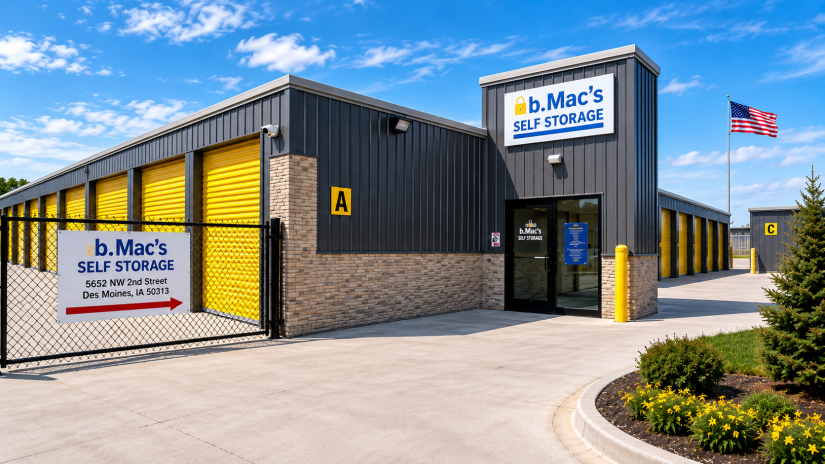
We're at 5652 NW 2nd Street in north Des Moines, right off Highway 415.
Call (515) 454-5433 and tell us what you're storing. We'll help you figure out the right size, give you honest pricing, and get you set up for the winter. No pressure. No surprise fees.
Protecting Your Stuff Through an Iowa Winter
Iowa winters are brutal. That's the climate we live in.
If you've got something worth protecting, whether it's a $3,000 motorcycle or a $150,000 RV, the decision you make about storage in October determines what condition it's in come April.
Spend a little now on climate-controlled storage, do the prep work right, and you'll pull it out in spring looking like it never left. Skip it and you're spending the summer fixing rust, mildew, and corroded engines.
The customers who come into b.Mac's in April wishing they'd stored it climate-controlled don't make that mistake again.
Ready for winter? Call b.Mac's Self Storage at (515) 454-5433 or stop by 5652 NW 2nd Street, Des Moines, IA 50313.
